Posts

Showing posts with the label ruff

Lion and Tiger Maine Coons

Image
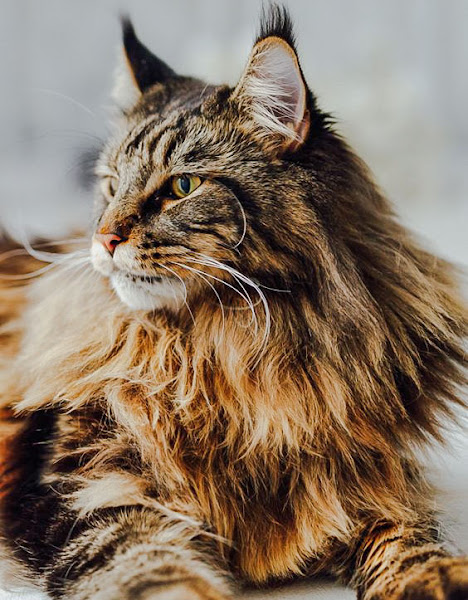
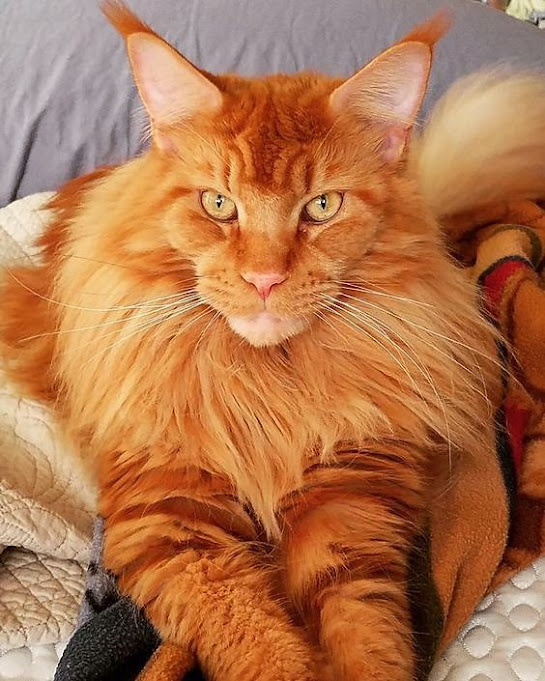
Here are two Maine Coons who resemble the lion (on the left) and the tiger. There is a distinct resemblance don't you think? Lion and Tiger Maine Coons. Image by MikeB. So, what is it about these two magnificent domestic cats that lead me to seeing this resemblance? Lion The Maine Coon ruff here is huge and although not in the same position as the lion's mane (!) it hints at it. And the reposed, relaxed state and confident facial expression also hint at the lion. Always the heavy muzzle of the Maine Coon allows the breed to be likened to these two big cats. The big cats have large muzzles too. The big error is that the ears of both the lion and tiger are - proportionate to their head size - considerably smaller than those of the Maine Coon. This is partly because the Maine Coon is meant to have big ears. They are unnaturally large and tall as per the breed standard. Here is a lion in repose: Picture is in the public domain to the best of my knowledge. Tiger Well, the heavy face...

Maine Coon coat is the single most important part of the cat's appearance

Image
The CFA breed standard guides breeders on the appearance of the breeds registered with that association. It is the same with the other breeds and associations. They award points for each aspect of the appearance with the overall total being 100. This allows judges to give an overall figure which is a percentage. The MC has a double coat of downy undercoat and a top coat but the coat is made up of three types of hair strand: down hairs (wool hairs), bristle or awn hairs and guard hairs . Technically there is a fourth type of hair: the whiskers. Maine Coon coat is the single most important part of the cat's appearance. Image: MikeB The aspect of the Maine Coon appearance (anatomy) to which is attached the most points in the coat. A show cat can be awarded a maximum of 20 points (20% of the total) for their coat in comparison to 15 for the head shape and 15 for the body shape. This 20% figure does NOT include body colour and pattern. The coat is therefore the most important single as...

When will my Maine Coon kitten develop her full coat and neck ruff?

Image
The 'experts' advise that Maine Coons develop slowly. You will see this all over the Internet. They say that a Maine Coon becomes fully developed at about four years of age. To that you have to add the fact that individual cats develop at different rates so there is some fluidity in that four-year guideline. Young Maine Coon yet to grow his ruff. Photo: Pinterest and in the public domain. However, it is pretty clear that young Maine Coons, perhaps below two years of age, normally or often have not fully developed their coat. One Maine Coon cat owner, Lisa Smith (on Quora.com), says that her two sibling male Maine Coons started to develop their ruffs after the age of two. One of the brothers had no ruff at all at two years old. She also says that they were getting stockier and heavier boned at two years old. Further, they started to grow what cat breeders call britches a.k.a. pantaloons on their hind legs . So it looks like it isn't just the ruff which can take time to de...

Exaggerated ruff of the modern Maine Coon

Image
I am not sure if this is a general trend but I am seeing Maine Coons with exaggerated ruffs. They are almost approaching the appearance of a lion's mane. Well, not quite but I'm beginning to call them manes and not ruffs. The picture below is an example.  TICA simply state that the ruff becomes more developed with age. They don't specify the dimensions of the ruff or whether it should be impressive or large or dramatic et cetera. On that basis, I presume that breeders have decided to take it upon themselves to make it look more impressive.  I'm not saying that I'm seeing these very large ruffs across the board but there are some incredibly impressive Maine Coons on the Internet with enormous ruffs, chiselled muzzles and gargantuan ears topped by a plume of paint brush-like hair! Left: exaggerated ruff. Pic in public domain. Right: standard ruff. Pic by Helmi Flick. The 'ruff' comes from menswear of the 1500s - the Elizabethan era. It is called neckwear. I...

Picture of a Maine Coon ruff marked out

Image
Picture of a Maine Coon ruff marked out! As if it needed it! Pic: Image by Mami Miyashima from Pixabay  The CFA breed standard is ambivalent about Maine Coons having a ruff. I had thought that they were obligatory for this cat breed but the standard does not support this viewpoint. Here is the relevant setion: COAT: heavy and shaggy; shorter on the shoulders and longer on the stomach and britches. Frontal ruff desirable.  So the ruff is 'desirable'. Not mandatory. The cat illustrated has the frontal ruff. I have seen ruffs far more pronounced than this. I wonder if a Maine Coon show cat would win if he or she did not have a ruff? Some of the outstanding Maine Coons that you see on the internet have these important features exaggerated such as the hair at the tips of the ears (lynx tipped ears), the massively square muzzle and of course a huge lion-like mane which is the ruff. The cat that you see in the photograph is not in anyway exaggerated. He or she is a standard-lookin...

Maine Coon Ruff

Image
The CFA breed standard makes the Maine Coon "ruff" desirable: COAT: heavy and shaggy; shorter on the shoulders and longer on the stomach and britches. Frontal ruff desirable . Texture silky with coat falling smoothly. It is interesting that it should be a "frontal ruff" whatever that means! It must mean that the ruff is predominantly at the front. The word "ruff" comes from the human clothes of Western, Central and Northern Europe from the mid-sixteenth century to the mid-seventeenth century. The picture of the Maine Coon on this page illustrates the ruff for this breed. Picture in the public domain It is a bit shaggy but Maine Coons should have shaggy coats. The ruff develops gradually. The picture below is of a human ruff. You can see the similarity! Cat breeders also refer to the term "britches" to describe the longer hair around the upper part of the hind leg . Johannes Verspronck  -  Frans Hals Museum, Haarlem.

Popular posts from this blog

The extreme Maine Coon face

Maine Coon Size - this is a huge one!

Average lifespan of Maine Coon cat

Comparison of a black smoke Maine Coon at 6 weeks and 6-years-of-age

Are Maine Coons illegal in some countries, states or territories?

5 Maine Coon transformations from kitten to adult (video)

Tortoiseshell Maine Coon with split-face

Eerie picture of a Maine Coon sitting like a human on a chest of drawers

A mightily beautiful orange Maine Coon

Today's Maine Coons are much larger and longer than the original