Posts

Showing posts with the label inherited diseases

RSPCA have seen a 300 percent increase in Maine Coons abandoned to their shelters over the last 6 years
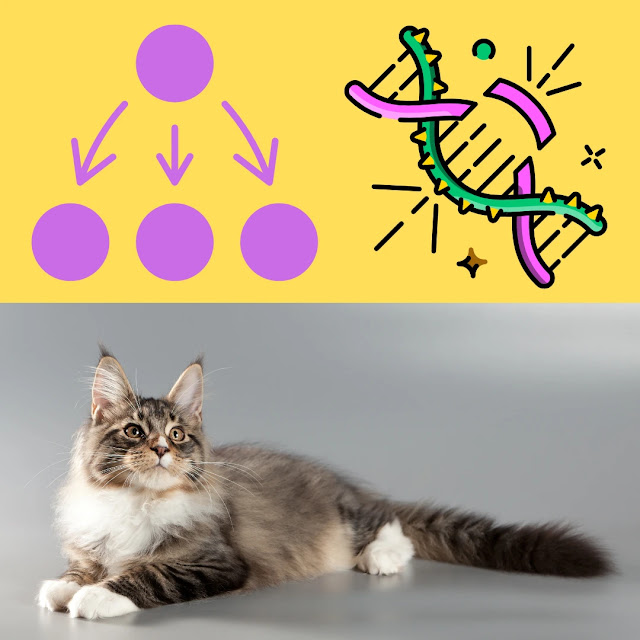
Image
Note: I don't wish to put people off buying a Maine Coon. They are amazing. But I just like addressing reality. A reality check to make sure adopters know all there is to know before diving in because it is expensive and you want to spend wisely and know what the overall cost over say 14 years will be for a Maine Coon (a lot 😓) The Mail Online has, I believe, helped people who are considering adopting one of the popular purebred cats. People want to buy a purebred cat need to think hard about the purchase - and it is a purchase with quite a lot of money being handed over - in terms of the health of the cat that they are buying and not so much the appearance. That advice in fact comes from the RSPCA who claim, correctly, that cat breeders tend to focus too much on appearance to try and create a cat which fits exactly cat association's breed standard rather than focusing on the health of the animal that they are creating. Ultimately, in the long-term, health is more important ...
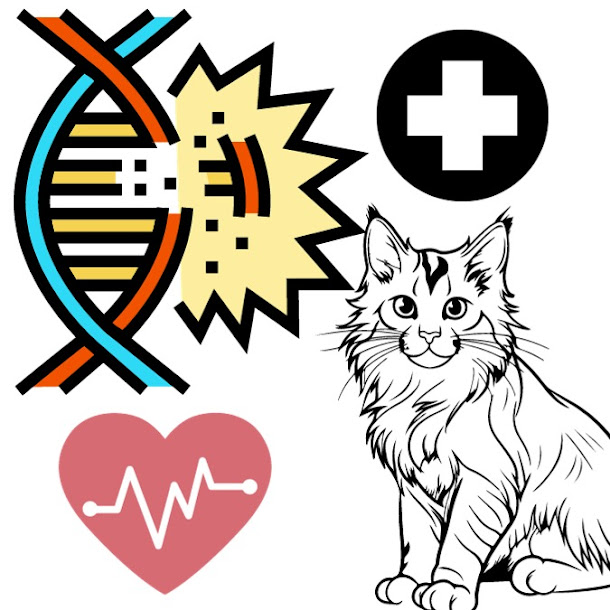
Some Maine Coons may inherit an increased bleeding tendency

Image
I have been digging around Google Scholar studies as I like to do sometimes! I was looking for some more information about Maine Coon cats and bumped into a study published on August 21, 2020 which investigated an inherited disease which results in an increased tendency to bleed.  The disease is called 'dysfibrinogenaemia' and it causes 'afibrinogenaemic haemorrhage', which had been previously reported in a Maine Coon cat. The scientists in this study concluded that:  "Dysfibrinogenaemia was identified in clinical cases and their healthy relatives, suggesting that this may represent a hereditary condition of Maine Coon cats. Clinicians should be aware of the increased potential for non-haemostasis in this cat breed and consider assessing clotting function before (elective) surgery." My interpretation of that statement is that some Maine Coon cats might inherit this disease which can cause increased bleeding which, in turn, would interest Maine Coon cat breeder...

Hip dysplasia in Maine Coons is not caused by the extra weight of the cat

Image
I have to keep this very brief. Scientists decided that the health problems associated with Maine Coons concerning the hind limbs namely hip dysplasia and patellar luxation are due to inheriting defective genes and not due to the extra weight of this cat breed which I decided years ago is the biggest domestic cat breed. In the words of the scientists: The authors therefore conclude that genetic or other causes may be involved in orthopaedic hind limb pathogenesis seen in MC cats more often than in other breeds. The word 'pathogenesis' means in this case the development and persists of diseases affecting the hind limbs of the Maine Coon. As you see they conclude that inherited genes cause the problem. They also meekly refer to 'or other causes' but there are none that I can think of and which would be plausible. Separately if hip dysplasia affects both legs it it worse. And bigger Maine Coons have worse cases of hip dysplasia. This may be because as the problem develops ...

Two mistakes that a Maine Coon purchaser should avoid

Image
There are two potentially big mistakes that a person who wants to purchase a Maine Coon might make and about which they should have some knowledge. They both concern the health of this cat. The problem with the popular Maine Coon cat breed is that the cats can inherit serious health conditions and a purchaser needs to know whether there have been DNA and other tests carried out to identify whether the Maine Coon cat in question carries the genetic mutation which gives the cat the disease. Three major inherited diseases So, for example, the Maine Coon cat is predisposed to inheriting the genetic disease known as Spinal Muscular Atrophy (SMA). It's a condition which can affect Maine Coon cats but there is a test available which can isolate this mutation. For example, Langford Vets advertise on the Internet their Molecular Diagnostic Unit, where a PCR-based assay can be carried out to quickly and accurately identify the SMA mutation in Maine Coon cats. Read about SMA in Maine Coons by...

Maine Coon cats can be predisposed to 'Haemophilia of Maine Coons'

Image
This is another medial article on the Maine Coon. I seem to be getting very proficient on medical topics because the Maine Coon does have a collection of inherited health issues which is disconcerting. The more I research Maine Coon health the more I realise that this popular cat breed could and should be healthier. Please use the search tool at the top-right of the page (desktop) to find other articles on Maine Coon inherited diseases. Maine Coon. Image in the public domain. I was doing some research on whether Maine Coon cats are predisposed to haemophilia. For those who are unsure, haemophilia is an inherited bleeding disorder in which the blood does not clot properly. I discovered that Maine Coons are predisposed to a different kind of haemophilia which can affect domestic shorthaired cats. That kind of haemophilia is called haemophilia a and B. It appears that more work needs to be done on 'Haemophilia of Maine Coons' but it is believed to be an autosomal (meaning not sex ...

Mode of inheritance of spinal muscular atrophy in Maine Coon cats

Image
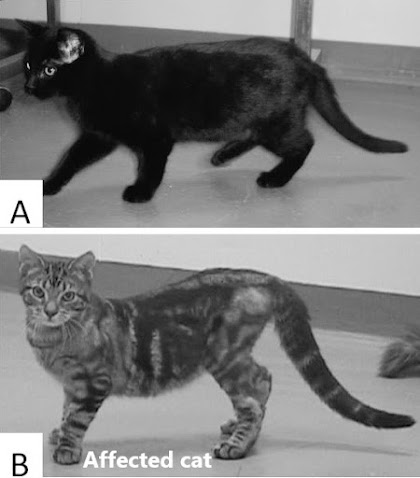
You may have heard of spinal muscular atrophy (SMA) in Maine Coon cats. It is one of those inherited diseases, several of which affect the Maine Coon, and as indicated in the title the muscles of the back become weakened which interferes with their normal activities such as jumping and walking.  These are not Maine Coons. Image in the public domain (believed). The cause is due to a loss of neurons in the first few weeks of life. The weakness becomes apparent at 3-4 months of age. Kittens walk with a strange gait and their hocks nearly touch the ground. The hock is the area from the end of the foot to the first part of the leg. RELATED: 15 facts about spinal muscular atrophy in Maine Coon cats. There should be no difficulty in diagnosing SMA being present in a Maine Coon cat. The disease is inherited as an autosomal (non-sex-linked) recessive mutated genetic trait. Genes come in pairs. If a Maine Coon cat has one copy of the mutated gene and one copy without the mutation they are re...

Maine Coons are popular because purchasers ignore health and are captivated by their appearance

Image
This is a slightly black, depressing article but the idea came to me a moment ago. The reason why the Maine Coon cat breed is in the top three most popular cat breeds in America and perhaps around the world is because the people who buy Maine Coon kittens from breeders are enamoured of the breed's appearance while apparently ignoring an aspect of this breed which is more important namely their health. And their health is not good. You might argue that this breed's health is dire. You might argue that it's shameful that such a handsome cat breed with such a fantastic history has been brought low through irresponsible and unethical breeding. I don't need to remind you about the health of this cat. But I will just touch on a few points. If you want to look into the health of this breed more, I would ask you to use the search facility at the top of the page. Or if you like click on this link because that will take you to the majority the articles about Maine Coon cat healt...

Maine Coons are 12 times more likely to develop "slipped capital femoral epiphysis (SCFE)

Image
A study discovered that Maine Coon cats are 12 times more likely to develop "slipped capital femoral epiphysis (SCFE). So, what is it and is this important? Maine Coon cats are 12 times more likely to develop "slipped capital femoral epiphysis (SCFE). Image: the study referred to (background). The overall image is by MikeB (Canva). It may interest Maine Coon cat owners and those who want to purchase a Maine Coon to know that this cat breed - in addition to inheriting a predisposition to hip dysplasia - also appears to inherit another hip joint condition which, as I understand it, can sometimes lead to hip dysplasia and this other condition is called slipped capital femoral epiphysis . It affects the hip joint. RELATED:  Infographic on hip dysplasia in Maine Coon cats . The study was published in 2016. It is online. You can read it if you wish by clicking on this link . The study was conducted in Austria. The interesting and perhaps disconcerting conclusion of the study, as me...

Negative screening for HCM in Maine Coon kittens does not rule out the disease

Image
In layperson's terms, we know that it's possible to screen Maine Coon breeding cats, foundation cats and the parents of kittens plus the kittens created at cat breeders for hypertrophic cardiomyopathy in order to prevent the creation of Maine Coon cats who are predisposed to hypertrophic cardiomyopathy (HCM) and therefore to reassure purchasers of purebred Maine Coon cats that their purchase will not show signs of the disease quite soon after purchase and have a shortened lifespan as a consequence. By 'screening' I mean testing for a mutant gene that causes the disease. When a Maine Coon breeder says that they screen their cats and kittens for the disease that they sell to clients, should a negative test result totally reassure the client that their purchased kitten will not develop HCM? That is the $64,000 question. The answer to that question is clearly NO , sadly. My research clearly indicates that a Maine Coon cat screened as negative for HCM may still develop this...

Ben the Vet would not purchase a Maine Coon cat

Image
You might have bumped into Ben the Vet on the internet . He is on TikTok giving his opinion as a British veterinarian about dogs and cats. The advice he gives is, of course, based on the knowledge he has gained as a veterinarian. He sees cats and dogs from a health perspective first and foremost. He also has his own non-medical preferences. My attitude on cats and dogs mirrors Ben's attitude. It is as if he is speaking for me. Of course, I am pleased about that. He stresses that they are his personal views. However, they are worth listening to because he is a very sensible person firstly and secondly the health of a dog or cat breed or random-bred cat is the most important criteria for choosing a pet. The next most important thing is behavior (character) and thirdly appearance. This is the exact reverse order of what actually happens for real. Never mind. The video explains the reason why he'd adopt a moggie - a random-bred or mixed-breed - cat. This means by implication he wo...

Hip dysplasia in Maine Coons is common and it can make them aggressive and harm their character

The presentation of hip dysplasia in Maine Coons is gradual with subtle behavioural changes such as inactivity or aggression, lack of response to human attention, reluctance to go up or down stairs, and resistance to handling. Here is a video I made to change the way I discuss these issues. They are very important issues. It surprises me that people discuss them more or hardly at all. Health is more important than appearance at the end of the day. That's what I think but it seems that I am out of step with almost everyone else!  The video that I have made, boring though it is, is the first I've seen on how hip dysplasia has a negative impact on the cat's character. In the video, I mention that people don't talk about this disease affecting character. What I mean is that the owners on TikTok proudly show off their cats which is understandable but they don't mention this important health issue. They wouldn't because it is a negative but it is important. @mikej...

Maine Coon hip dysplasia explained in an infographic

Image
This is a cross-post. I hope that it helps to explain hip dysplasia in Maine Coon cats. The x-rays that we see are not very helpful in terms of understanding the disease. So, I decided to produce a very compact and succinct infographic which I hope people will find useful because a lot of people look at websites on their smartphones. They are looking for speed. As I have said before, it is a great shame that this beautiful cat breed suffers from four serious inherited health problems one of which is hip dysplasia. The diseases don't come about exclusively because of artificial selection i.e. selective breeding but inbreeding is a major contributor to this disease being so prevalent at around a quarter of all Maine Coons. I can think of three others immediately: spinal atrophy, hypertrophic cardiomyopathy and patella luxation. The first concerns the spine gradually atrophying i.e. becoming weaker, the second regards a serious heart disease in which the muscle thickens. It begins wit...

How to make life better for the older Maine Coon cat companion (infographic)

Image
Maine Coons in general have shorter lifespans than the domestic cat population because of inherited diseases. Generally, with exceptions, there are more 'disabled' Maine Coons than in the general domestic cat population too because of the same reason. The infographic highlights some pointers that can make things a little better for elderly cats. It is a little strange to me to think that Maine Coons (MCs) become adults later than most domestic cats. I am not sure why but we are told that it might take until the age of 4 to become adult. By that time, they may have a heart murmur due to HCM.  Lifespan And we are also told that their average MC lifespan is around 12.5 years. The average moggie might add another 5 years to that. This is 40% more! Weird. Perhaps the data is slightly inaccurate.  But what is accurate is that MCs will be older earlier than normal in general - there will of course be exceptions. This I think makes the infographic useful. There is another usefulness. ...

How do I check if my Maine Coon has HCM?

Image
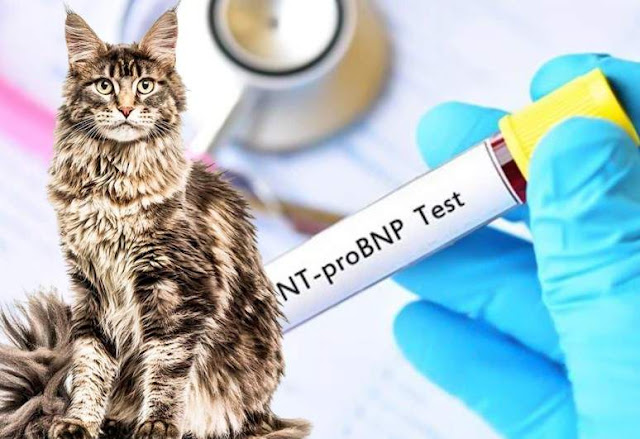
I think this is a reasonable question. It would certainly concern me if I lived with a Maine Coon. I'd be watching out for signs that my cat had developed HCM which is a well-known inherited disease to which this breed is predisposed. Does it generally worry Maine Coon caregivers? It can start when a cat is quite young. Blood test to check for HCM in Maine Coon. Image: MikeB from images in the public domain. Update 24 hours after publishing this page: it has been seen by 2 people!! No one gives a damn if their MC has HCM. That must be the message. There is no point in my writing these sorts of articles. So, you have possible signs that your cat has HCM. What to do? Only one thing: have some tests done at a good veterinarian who will do the following as I understand it: A physical check-up - listening to the heart and lungs and checking blood pressure. NT-proBNP – blood test that measures a heart stress hormone that can help detect heart disease. Electrocardiogram (ECG) – to measur...

How long do Maine Coons live?

Image
For me, to be very frank, the question is not that useful because it is encouraging me to generalise, and it is wrong to generalise on lifespan because it will vary between individual cats even when they are all Maine Coons.  Precious Maine Coon life beginning. Will he have a long life free of HCM? Image in public domain (as assessed). But I'm going to try and answer the question nonetheless because a well-known website on Maine Coons answers it and they say that you can expect Maine Coons to live beyond 12 years of age. Like I said, that's not extremely helpful. My assessment that their lifespan is 12 years! Not beyond it. See the update below if you want to cut to the chase. HCM the key It seems to me the discussion about Maine Coon lifespan should centre on a critically important inherited disease that affects this popular breed namely hypertrophic cardiomyopathy (HCM). A lot has been written about this heart disease. How does it affect lifespan? It must affect lifespan to ...

Spinal Muscular Atrophy in Maine Coon Cats

Image
This genetically inherited disease in Maine Coon cat needs to be discussed but I don't want to paint an unnecessarily negative picture about this wonderful and popular cat breed. The best book on cat health problems ( Cat Owner's Home Veterinary Handbook ) says on page 345 (latest edition at the date of this post) that this is "a genetic defect in Maine Coon cats". Cute ginger tabby MC sitting on his backside. Image in the public domain (believed). Spinal nerves die off that control the "skeletal muscles". The disease is evident at 3-4 months of age. The rear end of the cat sways and at about 5 months of age the cat cannot jump. There appears to be no pain and there is no treatment. The muscles decrease in size. A DNA test has been developed at the Laboratory of Comparative Medical Genetics at Michigan State University. Maine Coon cat owners send a cheek swab to the testing center to see if they are carriers before being bred. This is clearly a service for...

Admire the huge, magnificent Maine Coons but temper it with realism

Image
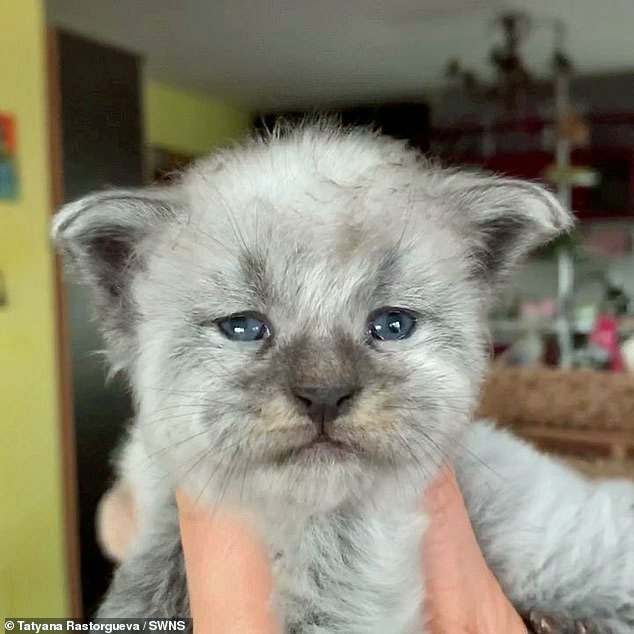
All of us admire the statuesquely impressive massive Maine Coons made famous by the internet's social media websites. They sock you in the face with their sheer size and lion-like, or human faces. Yes, we have seen those extraordinary human-faced Maine Coons from Europe. The MC (Maine Coon) has developed into the top 3 most popular cat breeds. I would expect the breed to be the world's most popular in coming years. Super, human-faced Maine Coon bred by a Russian but at what cost to health? Image credit: see image. Alright, let's enjoy humankind's creation of the MC. Yep, they are a human creation. When you see the stunning MC internet celebs you are not seeing the original MC that happily lived on a farm on the east coast of America. They were tiny and ordinary, almost dull by comparison to today's monsters. The MC cat show winners look rather sad compared to the huge MCs we are used to seeing . You are seeing a 'product' of human ingenuity which is designed...

How do I know if my Maine Coon has hip dysplasia (HD)?

Image
We know that hip dysplasia (HD) is pretty common in Maine Coon cats, regrettably . It should be something that Maine Coon cat owners are fully aware of, and I am sure that most of them are. I think that it should worry people who want to adopt a Maine Coon cat. It means that you are adopting a cat that is liable to end up disabled requiring special treatment and perhaps veterinary care. Anyway, that is another topic.  Although the breeders should do more about this as a matter urgency, but it appears to be accepted by the cat fancy which if true is remiss of them. Breeders would normally take steps such as eliminating cats with HD from the breeding programme but clearly this is not happening enough. Perhaps pet health insurance is appropriate , but the problem will be the high premiums because this is a known congenital condition.  Remember, too, that hip dysplasia is more common and worse in larger Maine Coons . It is a trade-off for the impressive stature of these huge cats....

Congenital hernia of the diaphragm overrepresented in Maine Coon cats

Image
The full inherited condition i.e. congenital condition is called 'peritoneopericardial diaphragmatic hernia (PPDH)' and in a study published on National Centre for Biotechnology Information website, it is described as being overrepresented in long-haired cat breeds including Maine Coons, Persians, Himalayans and longhaired random-bread cats.  I don't know how prevalent this condition is in Maine Coons. It might be very rare. And probably is. What are the symptoms?  According to petmd.com they include irregular heartbeat, labored breathing. The abdomen may move rapidly (palpitate) or feel empty. Reactions such as vomiting, diarrhea, and bloating can occur because of damage to the bowel or stomach. This is the first time I have heard about this. We know of the other inherited conditions in Maine Coons such as hip dysplasia and patella luxation together with hypertrophic cardiomyopathy (HCM) but this is a new one to my knowledge. The study on this was published in 2018. They ...

Largest DNA-based study - info. on Pyruvate Kinase Deficiency in Maine Coons

Image
A brand-new study published on June 16, 2022 which researched inherited diseases linked to a wide range of purebred cats and including non-pedigree cats, is proving useful. It is the largest DNA-based study of domestic cats to date according to the scientists. In all, 11,036 individual cat were genotyped. They included 10,419 pedigreed cats and 617 non-pedigreed cats.  DNA testing. Image: Pixabay. They were looking into the "distribution and frequency of known disease, blood type and physical trait associated genetic variance across cat breeds". I interpret this to mean that they were investigating inherited diseases in purebred cats and comparing that with non-purebred cats. I might oversimplify their stated objectives but it needs to be simplified. However, I am able to, I hope, simplify it having read hundreds of studies over the years. I'm going to go over some inherited diseases concerning the Maine Coon cat as reported by this study which may interest cat breeders a...

Popular posts from this blog

The extreme Maine Coon face

Maine Coon Size - this is a huge one!

Comparison of a black smoke Maine Coon at 6 weeks and 6-years-of-age

Average lifespan of Maine Coon cat

Eerie picture of a Maine Coon sitting like a human on a chest of drawers

Tortoiseshell Maine Coon with split-face

Are Maine Coons illegal in some countries, states or territories?

Difference between Maine Coon and domestic long hair

No part of a Maine Coon cat should be exaggerated

2 top Russian Maine Coon cat breeders which ship internationally