Posts

Showing posts with the label spinal muscular atrophy

Mode of inheritance of spinal muscular atrophy in Maine Coon cats
Image
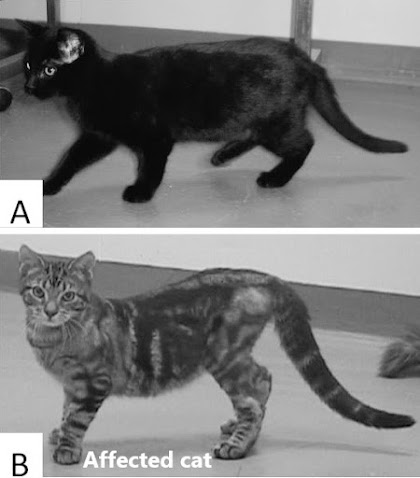
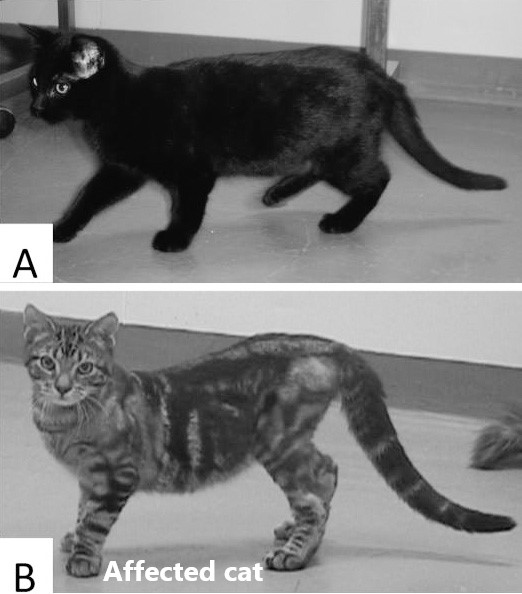
You may have heard of spinal muscular atrophy (SMA) in Maine Coon cats. It is one of those inherited diseases, several of which affect the Maine Coon, and as indicated in the title the muscles of the back become weakened which interferes with their normal activities such as jumping and walking.  These are not Maine Coons. Image in the public domain (believed). The cause is due to a loss of neurons in the first few weeks of life. The weakness becomes apparent at 3-4 months of age. Kittens walk with a strange gait and their hocks nearly touch the ground. The hock is the area from the end of the foot to the first part of the leg. RELATED: 15 facts about spinal muscular atrophy in Maine Coon cats. There should be no difficulty in diagnosing SMA being present in a Maine Coon cat. The disease is inherited as an autosomal (non-sex-linked) recessive mutated genetic trait. Genes come in pairs. If a Maine Coon cat has one copy of the mutated gene and one copy without the mutation they are re...
Is spinal muscular atrophy (SMA) in Maine Coon cats painful?

Image
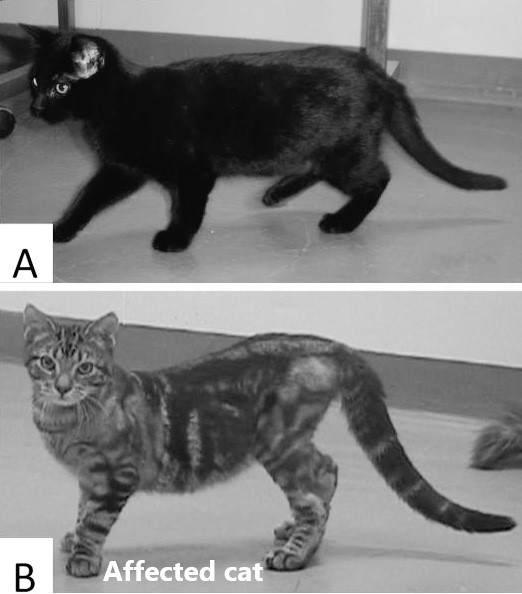
Answer to the title question:  While SMA can cause discomfort and weakness, it is not typically considered a painful condition in cats  (source: ChatGPT) .  That does not say it does not cause pain. It does say that it causes discomfort which is a mild form of pain isn't it?! This is one of several inherited diseases linked to this cat breed, all of which cause discomfort to varying degrees. Hip dysplasia simply causes pain, bad pain I'd suggest as it causes arthritis - bone on bone. There is a question mark over whether it is cruel to breed this cat under the current circumstances as managed by the cat associations .  They accept these problems. They should not. It is unethical to continue breeding cats like this. Note: UC Davis in the US have a DNA test for this disease. Affected by SMA. Image in public domain believed. RELATED: the above picture accompanies a page on 15 facts about this disease -  LINK . Spinal muscular atrophy (SMA) is a genetic disorder tha...

15 facts about spinal muscular atrophy in Maine Coon cats

Image
Here are 15 facts about spinal muscular atrophy (SMA) in Maine Coon cats. SMA in a young non-Maine Coon. Image believed to be in the public domain and from a study: "Failure of lower motor neuron radial outgrowth precedes retrograde degeneration in a feline model of spinal muscular atrophy." SMA is an inherited genetic disease in Maine Coon cats causing a decreased muscle mass. If two carrier cats, that is cats which are heterozygous to the disease which means they carry one copy of the gene mutation, are mated there is a 25% probability of the offspring being affected. This means that 25% of the offspring will be homozygous to the disease which in turn means that they have two copies of the gene mutation. The disease will be present in them. The disease affects the spinal cord nerves that control the skeletal muscles of the body and legs. The spinal cord nerves die off. The disease is evident at about 3 to 4 months of age. Kittens move with a sway in the rear end. By the ag...

Spinal Muscular Atrophy in Maine Coon Cats

Image
This genetically inherited disease in Maine Coon cat needs to be discussed but I don't want to paint an unnecessarily negative picture about this wonderful and popular cat breed. The best book on cat health problems ( Cat Owner's Home Veterinary Handbook ) says on page 345 (latest edition at the date of this post) that this is "a genetic defect in Maine Coon cats". Cute ginger tabby MC sitting on his backside. Image in the public domain (believed). Spinal nerves die off that control the "skeletal muscles". The disease is evident at 3-4 months of age. The rear end of the cat sways and at about 5 months of age the cat cannot jump. There appears to be no pain and there is no treatment. The muscles decrease in size. A DNA test has been developed at the Laboratory of Comparative Medical Genetics at Michigan State University. Maine Coon cat owners send a cheek swab to the testing center to see if they are carriers before being bred. This is clearly a service for...

Popular posts from this blog

The extreme Maine Coon face

Maine Coon Size - this is a huge one!

Comparison of a black smoke Maine Coon at 6 weeks and 6-years-of-age

Average lifespan of Maine Coon cat

Eerie picture of a Maine Coon sitting like a human on a chest of drawers

Tortoiseshell Maine Coon with split-face

Are Maine Coons illegal in some countries, states or territories?

Difference between Maine Coon and domestic long hair

No part of a Maine Coon cat should be exaggerated

2 top Russian Maine Coon cat breeders which ship internationally