Posts

Showing posts with the label genetic mutations

Some Maine Coons may inherit an increased bleeding tendency
Image
I have been digging around Google Scholar studies as I like to do sometimes! I was looking for some more information about Maine Coon cats and bumped into a study published on August 21, 2020 which investigated an inherited disease which results in an increased tendency to bleed.  The disease is called 'dysfibrinogenaemia' and it causes 'afibrinogenaemic haemorrhage', which had been previously reported in a Maine Coon cat. The scientists in this study concluded that:  "Dysfibrinogenaemia was identified in clinical cases and their healthy relatives, suggesting that this may represent a hereditary condition of Maine Coon cats. Clinicians should be aware of the increased potential for non-haemostasis in this cat breed and consider assessing clotting function before (elective) surgery." My interpretation of that statement is that some Maine Coon cats might inherit this disease which can cause increased bleeding which, in turn, would interest Maine Coon cat breeder...

Note about Maine Coon polydactylism including patty-foot and mitten-paw

Image
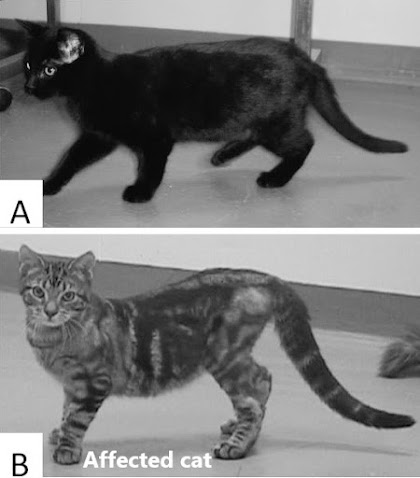
Mitten-paw and patty-foot. Image: MikeB based on images from the study mentioned in the article. Here's a short note with some information about polydactylism in Maine coon cats. Polydactyly definition: I think I might start off with a definition of polydactyly. It is usually defined in relation to humans where it means "a condition in which a baby is born with one or more extra fingers." It means, therefore, that a cat is born with more than the normal number of toes and it can affect both hind and forepaws but normally affects the forepaws. High prevalence : there is a high prevalence of polydactylism in Maine Coon cats. We don't have an exact percentage of Maine Coon cats that are polydactyly but it's probably around 40% or 4 in 10 cats have more than the usual number of toes. Variable appearance: what I mean here is that, in scientific language, the "phenotypic expression of polydactyly showed great variability". The word "phenotypic" mea...

Mode of inheritance of spinal muscular atrophy in Maine Coon cats

Image
You may have heard of spinal muscular atrophy (SMA) in Maine Coon cats. It is one of those inherited diseases, several of which affect the Maine Coon, and as indicated in the title the muscles of the back become weakened which interferes with their normal activities such as jumping and walking.  These are not Maine Coons. Image in the public domain (believed). The cause is due to a loss of neurons in the first few weeks of life. The weakness becomes apparent at 3-4 months of age. Kittens walk with a strange gait and their hocks nearly touch the ground. The hock is the area from the end of the foot to the first part of the leg. RELATED: 15 facts about spinal muscular atrophy in Maine Coon cats. There should be no difficulty in diagnosing SMA being present in a Maine Coon cat. The disease is inherited as an autosomal (non-sex-linked) recessive mutated genetic trait. Genes come in pairs. If a Maine Coon cat has one copy of the mutated gene and one copy without the mutation they are re...

Negative screening for HCM in Maine Coon kittens does not rule out the disease

Image
In layperson's terms, we know that it's possible to screen Maine Coon breeding cats, foundation cats and the parents of kittens plus the kittens created at cat breeders for hypertrophic cardiomyopathy in order to prevent the creation of Maine Coon cats who are predisposed to hypertrophic cardiomyopathy (HCM) and therefore to reassure purchasers of purebred Maine Coon cats that their purchase will not show signs of the disease quite soon after purchase and have a shortened lifespan as a consequence. By 'screening' I mean testing for a mutant gene that causes the disease. When a Maine Coon breeder says that they screen their cats and kittens for the disease that they sell to clients, should a negative test result totally reassure the client that their purchased kitten will not develop HCM? That is the $64,000 question. The answer to that question is clearly NO , sadly. My research clearly indicates that a Maine Coon cat screened as negative for HCM may still develop this...

Majestic solid blue male Maine Coon is perfect right down to his nose leather

Image
Well, if you are interested in buying/adopting a blue Maine Coon, this is the sort of cat you should be considering. So perfectly Maine Coon. So handsome and distinguished. So much so that it is almost undignified that he is playing (reluctantly) with the tease waved in front of his face. Majestic blue male Maine Coon is perfect right down to his nose leather. Image: Instagram. This is the CFA breed standard for Maine Coon Colors - solid color class. You can see that there are five different solid colours allowed for this cat breed under the Cat Fanciers' Association. WHITE: pure glistening white. Nose leather and paw pads: pink.  BLACK: dense coal black, sound from roots to tip of fur. Free from any tinge of rust on tips or smoke undercoat. Nose leather: black. Paw pads: black or brown.  BLUE: one level tone from nose to tip of tail. Sound to the roots. Nose leather and paw pads: blue.  RED: deep, rich, clear, brilliant red; without shading, markings, or ticking. Lips an...

Some dog breeds are predisposed to polydactylism like the Maine Coon

Image
Polydactyl paw of a dog. Screenshot. One aspect of the Maine Coon that helps to make it a famous cat breed is that it is predisposed to polydactylism. This almost totally benign genetic mutation was more common in the past than it is today as the breeders (some or all?) have selectively bred it out of their breeding lines as it disqualifies cats in CFA cat shows but not TICA cat shows where they have a special polydactyly Maine Coon (MC) category.  Back in the day when the MC was a barn cat say in the early-mid 1800s I bet there were a lot more polydactyl MCs. I questioned whether certain dog breeds experienced the same genetic mutation and Ben the Vet on TikTok tells me that there are. He does not specify dog breeds but a quick internet search found the following breeds predisposed to the genetic mutation: Norwegian Lundehund The Great Pyrenees The Beauceron Akita Anatolian Shepherd Rottweiler Jindo The Catalan Sheepdog Shiba Inu The Estrela Mountain dog Australian Shepherd Kor...

Why do Maine Coons have extra toes?

Image
There are several issues to discuss when responding to the question in the title. It appears that some people think that all Maine Coon cats have extra toes. This is incorrect.  Huge white polydactyl Maine Coon. Image: Pinterest. Not all Maine Coons are polydactyl Sarah Hartwell in her website is one of the few providers of information on polydactylism in Maine Coon cats to state that "historically, the polydactyl made up 40% of the original unregistered Maine Coon population". Note that she says "unregistered". These are Maine Coon cats which were not registered to a cat association. I take that to mean that these were not officially Maine Coons and perhaps she is referring to the Maine Coon before they became a purebred, pedigree cat (see below as well).  Falling percentage It's quite a high percentage which has been dramatically reduced since the Maine Coons became a registered purebred cat because, for example, the Cat Fanciers' Association does not reco...

Discussing the gene which dictates hair length in Maine Coon cats

Image
Under the Cat Fanciers' Association (CFA), the Maine Coon coat should be heavy and shaggy, shorter on the shoulders and longer on the stomach and britches. A full-frontal ruff is desirable, and the coat texture should be silky with the coat falling smoothly. That's the breed standard. Cream Maine Coon with shaggy fur. Image: Pinterest. A study published in October 2021 (see full citation at base of article) which is quite recent, found that the gene which causes long hair in cats can be heterozygous or homozygous and this affects the "longhair phenotype in about 3% of these cats". That's a reference to Maine Coon cats. Heterozygous means "having two different alleles of a particular gene or genes" while homozygous means having two identical alleles. It's a tricky subject to discuss but research indicates that hair length in domestic cats varies a lot, and this variation is due to mutations of the recessive gene known as the: fibroblast growth factor ...

Round up of the genetic mutations causing HCM in Maine Coons

Image
I have decided to do what I would call a 'round up' of the mutated genes behind the disastrous inherited heart disease of hypertrophic cardiomyopathy (HCM) in this very popular domestic cat breed which is in top three most popular breeds on some polls .  Mutated genes cause HCM in Maine Coons, but the problem is fixable by removing studs and queens with the mutation from breeding lines. Why isn't this happening? Image: MikeB By 'round up' I mean pulling together the strands of information that I have discovered about the causes of this disease from research conducted over many years. I have endeavoured to use plain English at all times as this is a very technical topic. A round up is needed because different research projects have come to apparently different findings, but they are overlapping as in all cases the genetic mutation responsible has a negative impact on the creation of heart muscle such that HCM is programmed to occur at some stage in the affected cat...

Knowing the early signs of hypertrophic cardiomyopathy in Maine Coon cats

Image
Respected sources of information on hypertrophic cardiomyopathy (HCM) in Maine Coon cats tell us that about 30% (25%-33%) of Maine Coons have a genetic mutation that makes them likely that they will develop HCM which is a thickening of the muscle walls of the heart leading to heart failure and other complications such as an increased risk of blockage. So, what are the signs that your Maine Coon cat is developing HCM? Image: MikB based on images in the public domain: heart: Wikipedia and MC: Pixabay. The genetic mutation referred to is a defective gene which is autosomal dominant. It affects both males and females. One copy of the gene may lead to the disease. RELATED: Mavacamten is slated as a possible new drug for HCM in Maine Coon cats . Test for genetic mutation In the US, the Veterinary Cardiac Genetics Laboratory at the Washington State University College of Veterinary Medicine can test cats for this defect using a cheek swab or a blood test. That information was valid in about th...

Dilute tortoiseshell Maine Coon (genetics explained)

Image
The dilute tortoiseshell is a 'faded' tortoiseshell coat. It is as if all the bright tortoiseshell colours are faded and muted. It is a very popular coat type although relatively rare compared to the standard tortoiseshell coat.  Dilute tortoiseshell Maine Coon. Photo by Robert Sijka. Purely in terms of appearance of any object, the slightly worn and used look is attractive to a lot of people. I can think of many products which look better used than when brand new. The black Leica rangefinder camera comes to mind (I used to be a professional photographer). Well, the dilute tortoiseshell coat of a domestic cat is a bit like that 😎😉. Some people like it and some don't like it as much as the brightly coloured original. You may know that this appearance of diluted colours is due to a mutant form of the genes which normally ensure that the pigment granules are deposited evenly throughout the hair strands. In the "mutant form" the pigment granules are enlarged "a...

Genetic mutation of MYBPC3-A31P linked to HCM in 41.4% of European Maine Coons

Image
The MYBPC3 gene gives instructions to the body of developing Maine Coons to make cardiac myosin binding protein which is part of heart muscle cells. Cardiac MyBP-C is linked to a basic unit of muscle contraction. When the MYBPC3 is mutated, it is associated with a significant increased risk of the development of the well-known heat disease called hypertrophic cardiomyopathy for which the Maine Coon is also well-known to suffer from. It is one of several inherited disease very sadly affecting this impressive a popular cat breed . Genes and chromosomes. Image in the public domain. The mutated gene is also referred to as 'cardiac myosin-binding protein C3 mutations'. The mutated MYBPC3-A31P gene was identified in a colony of Maine Coons way back in 2010. So, it is present in the USA. A study (see title below) was concerned with its prevalence in European Maine Coons. The researchers assessed 3757 cats from different breeds including 2744 Maine Coon cats for this mutation. The muta...

What causes polydactyl Maine Coon cats?

Image
We know that the Maine Coon is predisposed to polydactyly. The Maine Coon cat breed is famous for cats having more than the usual number of toes. In fact, it wasn't until very recently that the polydactyl Maine Coon was accepted by The International Cat Association (TICA). Polydactyl Maine Coons are not accepted by the Cat Fanciers' Association (CFA) as at the date of this post. Polydactyl MC. Image in public domain. RELATED:  Polydactylism was deliberately bred out of the Maine Coon . A study report on SAGE Journals regarding: 'Genetic heterogeneity of polydactyly in Maine Coon cats', concluded that "polydactyly in Maine Coon cats is inherited as an autosomal dominant trait with incomplete penetrance and variable expressivity and this trait is characterised by genetic heterogeneity in the Maine Coon breed". RELATED:  Polydactyl cat record holders 2022 . It might be helpful the break that information down a bit if we can. "Polydactyly" is another wor...

Genetic mutation causing HCM in American Maine Coon cats not present in European cat population

Image
Scientists screened 3757 cats from different cat breeds in America including 2744 Maine Coon cats for a genetic mutation called MYBPC3-A31P, which the scientists say has been identified in the USA in a colony of Maine Coon cats suffering from autosomal dominant hypertrophic cardiomyopathy (HCM). I'm not sure whether this is THE genetic mutation which causes HCM and Maine Coon cats. It probably isn't. The genetic mutations causing HCM in domestic cat is a complex subject. But let's say that this is at least one genetic mutation which alters the creation of muscle fibres in the heart causing the heart wall to thicken leading to this inherited health problem. Young Maine Coon with human face. How healthy is she/he? Photo as per bottom-left on image. Note: I am not suggesting that this cat has HCM or has been poorly bred. The results of the study pointed to the fact that this mutation is only found in Maine Coon cats with a prevalence of 41.5%. They found one exception which...

Prevalence of a genetic mutation in Maine Coons causing HCM in comparison to other cat breeds

Image
This is a table showing the prevalence of a genetic mutation in Maine Coons causing HCM in comparison to other cat breeds in which it is not present as per the chart. HCM is a well-known heart disease in cats. It stands for hypertrophic cardiomyopathy. Tabby Maine Coon. Photo in public domain. This is a study which discusses how common a genetic mutation is in Maine Coon cats which is responsible for the heart disease called HCM in that cat breed. The scientists identified a dominant mutation in what is called the myosin-binding protein C (MYBPC3) gene of Maine Coons (MCs). I know I am repeating myself but I think it helps. The study wanted to find out how prevalent it was in this attractive and popular cat breed. The table show below shows you. It is highly prevalent and, on this table, exclusive to the MC.   The study concerned 3,310 cats which were mainly Maine Coons. It's a retrospective study in which they reviewed other studies. As I understand it, blood samples for DNA te...

Prevalence of A31P mutation in the Maine Coon population is around 26%

Image
Like many purebred cats, the Maine Coon can suffer from inherited genetic illnesses which is a great shame because it is a stain on the breeding of this wonderful American cat. This beautiful cat can inherit at least five diseases one of which is hypertrophic cardiomyopathy a.k.a. HCM. And, to the best of my knowledge, it is still work in progress as to what mutated genes cause this disease. One of them is the A31P mutation referred to in the title. I have an article on another heart disease caused by a genetic mutation which can read by clicking on this link . Glorious Maine Coon. The presence of the photo does not infer that this cat suffers from an inherited disease. Photo in the public domain. The figure of 26%, referred to in the title, comes from Langford Vets who provide cat genetic testing to help breeders and I presume veterinarians and cat owners understand whether their cats or cat carry one of these genetic mutations. They are based in Bristol, UK. Their Molecular Diagn...

Girly-looking Maine Coon beauty in a snowy place

Image
The snow sort of adds to the image. And this is an impressive image because the cat is so impressive. What a beauty she is. Girly-looking Maine Coon beauty in a snowy place. Photo: Twitter. This very large cat looks distinctly female which is almost certainly true because nearly all calico cats (tortoiseshell-and-white) and tortoiseshell cats are female due to the genetic link between sex and coat type. This cat's face is distinctly female for me. Very girly. Sometimes you can tell the gender of a cat from their face because some feline faces are distinctly female or male. But on other occasions it is not so clear. As cat owners we don't pay much attention to the fact that our cat might look masculine or feminine. This is a good and we should take that attitude forward in our relations with humans! Less judging people on their appearance and more on their behavior. And a more open mind to appearance would help in the drive for equality and less prejudice. A bit about the rar...

Maine Coon cats predisposed to more than one type of heart disease

Image
We know that Maine Coon cats are predisposed to hypertrophic cardiomyopathy (HCM) and in fact about 30% of Maine Coon cats have a genetic mutation that predisposes them to HCM. However, a research lab did some work on a Maine Coon cat owned and living with Kathy Janson. The lab is based at the University of Cincinnati. A researcher there is Sakthivel Sadayappan, PhD.  Janson's Maine Coons were dying of HCM prematurely but in this instance they analysed the blood of Janson's cat, Freddie, and they were surprised to find that he did not have the more common mutation linked to HCM. Sakthivel Sadayappan, PhD, shown in the University of Cincinnati College of Medicine. Photo: Colleen Kelley/University of Cincinnati The researchers: Sadayappan and his postdoctoral fellow, James McNamara, Ph.D, used genetic sequencing from blood acquired from Freddie's parents to look for genetic variants i.e. mutations. They found that both of his parents had one mutated copy of troponin-...

Popular posts from this blog

The extreme Maine Coon face

Maine Coon Size - this is a huge one!

No part of a Maine Coon cat should be exaggerated

Comparison of a black smoke Maine Coon at 6 weeks and 6-years-of-age

Eerie picture of a Maine Coon sitting like a human on a chest of drawers

Difference between Maine Coon and domestic long hair

Black smoke Maine Coon Richie with a black face and diamond eyes

Tortoiseshell Maine Coon with split-face

2 top Russian Maine Coon cat breeders which ship internationally

Average lifespan of Maine Coon cat