Posts

Showing posts with the label study

Aficamten for the treatment of HCM in the Maine Coon and other cats

Image
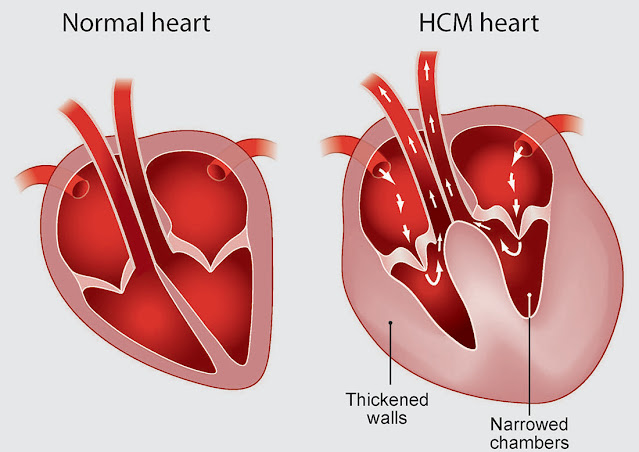
Aficamten for the treatment of HCM in the Maine Coon and other cats. Image: MikeB A study - referred to at the end of the article - concludes with the words below in testing a new drug called aficamten  for the treatment of hypertrophic cardiomyopathy (HCM) in cats of which the Maine Coon is perhaps the best known cat breed to suffer from this inherited disease. "A single dose of aficamten significantly decreased LV systolic function and improved LVOTO, both of which are harmful aspects of this disease process that contribute to the pathogenesis." The sentence above describes the effects of this medication called aficamten on a condition that causes abnormal function in the left ventricle of the heart which is how HCM is manifested in cats and people. The left ventricle becomes enlarged and malfunctions. Here's a breakdown: A single dose of aficamten significantly decreased LV systolic function: Aficamten reduces the pumping ability of the left ventricle (LV) to a noticea...
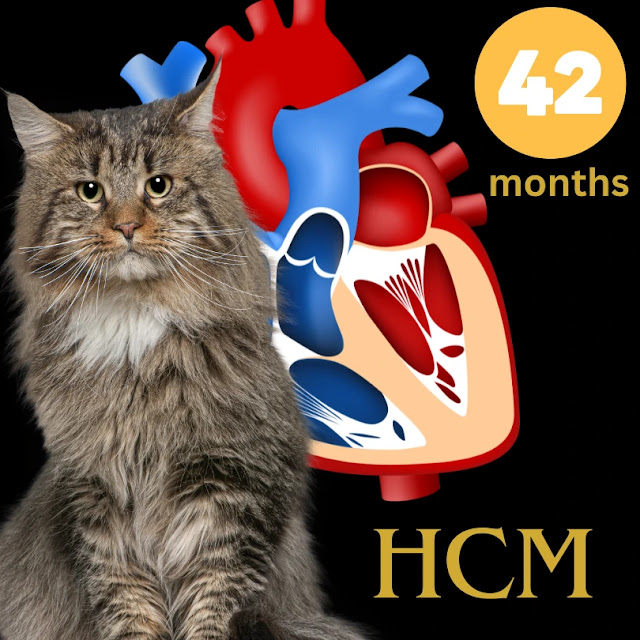
Average survival of cats diagnosed with HCM is a further 3.5 years per a study

Image
This is a remarkable study for its conclusion. It was conducted in 2010.The scientists evaluated a population of 127 cats who'd been treated at the Royal Veterinary College Queen Mother Hospital for Animals in the UK between 1997 and 2005. The cats included some purebred cat including Ragdolls. They concluded that "Overall median survival from date of hypertrophic cardiomyopathy diagnosis at the Queen Mother Hospital for Animals was 1276 days".  This is saying that cats taken to this animal hospital for diagnosis and having been diagnosed with hypertrophic cardiomyopathy (HCM) lived for a further 3.5 years.  Comment: a very short time. Clearly the age of the cat when diagnosed is a factor which dictates the length of time that they have to live.  Younger cats lived longer after being diagnosed with HCM. That's pretty obvious and HCM can affect young cats around 4 months old. That said, we know that Maine Coons and Ragdolls are just 2 breeds with a history of HCM. The...

Physical attributes that might indicate that your Maine Coon cat is predisposed to HCM

Image
As a Maine Coon cat caregiver you almost certainly know that the breed is genetically predisposed to developing hypertrophic cardiomyopathy (HCM). In my view, this disease, which can start early in life, is the reason why Maine coon cats have, on average, a shorter lifespan than they should otherwise have. One study says that their lifespan, on average, is 11 years .  It's a great shame that through suboptimal breeding, this majestic cat breed is so predisposed to this serious disease. Omar an overweight Maine Coon cat who's probably predisposed to HCM. Image: Screenshot from a YouTube video. Omar lives in Australia. The study that I'm referring to observed certain anatomical characteristics of Maine Coon cats that were predisposed to HCM. They decided this because the Maine Coon cats in their cohort (group) of 63 cats that had HCM commonly had these anatomical characteristics. They are as follows: Older: This is to be expected. Older Maine Coon cats are more likely to hav...

Maine Coon cat has a shorter lifespan than the Birman and the Norwegian Forest Cat

Image
I'm able to access the full report by a group of scientists who looked at the mortality of life-insured Swedish cats both non-purebred and purebred. They compared the mortality rate for two periods of time, one more recent than the other (1999-2002 compared to 2003-2006). They published a chart showing the percentage of cats who died by the age of five, by the age of 7.5 years, by the age of 10 years and by the age of 12.5 years. RELATED:  Comparing Maine Coon, Norwegian Forest and Siberian Cats . Maine Coon In the earlier period, 41% of Maine Coon cats survived until 12.5 years of age and beyond. In the second more recent period, 54% of Maine Coon cats survived until 12.5 years of age. The increased lifespan is probably due to an increase in taking out an insurance premium (usually expensive). Birman For the Birman the percentages were 58% and 68% respectively. In other words, over the more recent period, 68% of Birman cats lived to 12.5 years of age and beyond, which as you can s...

Buying solid white Maine Coon kittens and the chances of deafness

Image
This is a report in layman's terms of congenital sensorineural deafness (CSD) in white blue-eyed cats of various breeds including the Maine Coon cat. The word 'sensorineural' refers to the nervous system transmitting sound signals from the ears to the brain to perceive sound. CSD concerns a defect that a cat is born with affecting the nerves that transmit sound to the brain. It is the dominant white gene (W) which can damage the hearing of cats. RELATED:  Why are domestic cats white ? Good chance of suffering from CSD. Image now in the public domain. In all, 122 white purebred kittens and 61 coloured kittens between the ages of 6-21 weeks were examined. The occurrence of CSD in solid white kittens overall was 30.3% with deafness in both ears at 15.9% and deafness in one ear at 14.4% (unilateral). Deafness was more common in white kittens with blue irises. When the kitten had one blue iris the occurrence of deafness was at 44.4%. When both eyes had blue irises the occurrenc...

Maine Coon sociability towards other cats and humans

Image
This is a very short note based upon a study which I'm currently reading on the cat breeds. In one part of the study they assessed breed differences in respect of sociability towards cats, sociability towards humans and activity/playfulness. The Maine Coon performed as follows: Sociability towards cats: the Maine Coon is in the bottom four under this criteria. It is below average in terms of sociability towards other cats. How does one interpret that? On a strict sense one must be driven to the conclusion that Maine Coon cats are less likely to make friends or be friendly with other domestic cats in a multi-cat home. I don't see this trait having a big effect on caregiving. Another possibility is that this breed may be more hostile than average towards strange cats coming onto their home range. Sociability towards humans: the Maine Coon cat does slightly better under this heading as they are near the midpoint of all the breeds in terms of sociability towards humans but a litt...

Note about Maine Coon polydactylism including patty-foot and mitten-paw

Image
Mitten-paw and patty-foot. Image: MikeB based on images from the study mentioned in the article. Here's a short note with some information about polydactylism in Maine coon cats. Polydactyly definition: I think I might start off with a definition of polydactyly. It is usually defined in relation to humans where it means "a condition in which a baby is born with one or more extra fingers." It means, therefore, that a cat is born with more than the normal number of toes and it can affect both hind and forepaws but normally affects the forepaws. High prevalence : there is a high prevalence of polydactylism in Maine Coon cats. We don't have an exact percentage of Maine Coon cats that are polydactyly but it's probably around 40% or 4 in 10 cats have more than the usual number of toes. Variable appearance: what I mean here is that, in scientific language, the "phenotypic expression of polydactyly showed great variability". The word "phenotypic" mea...

Ramipril an ACE inhibitor does not benefit Maine Coons with HCM without congestive heart failure

Image
Maine Coon photo copyright Helmi Flick. This is very much a 'normal' Maine Coon not bred to extreme. Introduction I am not a veterinarian I am good at research I am good at understanding medical/scientific studies I can summarise them into plain English --------------------- Ramipril is an ACE inhibitor. ACE stands for "Angiotensin-converting enzyme". ACE inhibitors such as Ramipril are medications that help relax the veins and arteries to lower blood pressure.  Key point: ACE inhibitors prevent an enzyme in the body from producing angiotensin II, a substance that narrows blood vessels.  Alternative names for Ramipril include: Lopace, Ramipril, Triapin, Triapin Mite, Tritace (British Heart Foundation). The study I am referring to is: The Effect of Ramipril on Left Ventricular Mass, Myocardial Fibrosis, Diastolic Function, and Plasma Neurohormones in Maine Coon Cats with Familial Hypertrophic Cardiomyopathy without Heart Failure. Link to study abstract:  https://doi.o...

Indicators that a Maine Coon may be predisposed to HCM - hypertrophic cardiomyopathy (heart disease)

Image
Indicators that a Maine Coon may be predisposed to HCM - hypertrophic cardiomyopathy (heart disease). Image by MikeB Scientists looked at some possible indicators that a Maine Coon might be predisposed to developing HCM in their lives. Their conclusion was that the following signs may indicate a predisposition: low birth weight and catch up with rapid growth through good nutrition after poor nutrition as an embryo. obesity. neutered cat, which is linked to 2 above. heavier. long forelimb bones connecting the elbow and shoulder (humerus). Conclusions of the study Below are some extracts from the study. They are technical but they are here for completeness and they may interest some readers. 1. These data support the hypothesis that early growth and nutrition, larger body size and obesity may be environmental modifiers of genetic predisposition to HCM. Further studies are warranted to evaluate the effects of early nutrition and growth on the phenotypic expression of HCM 2. Low birth wei...

Maine Coons appear to be at a higher risk of peritoneopericardial diaphragmatic hernia (PPDH)

Image
A study which has been published online and which you can see by clicking on the following link:  https://doi.org/10.5326/0460398 , concluded that longhaired cats of varying breeds particularly Maine Coon cats appear to be at a higher risk of PPDH.  Maine Coons appear to be at a higher risk of peritoneopericardial diaphragmatic hernia (PPDH). Image: Clinician's Brief. "Peritoneopericardial diaphragmatic hernia" describes the most common congenital defect involving the pericardium in dogs and cats. In this defect, the abdominal contents are herniated (to protrude through an abnormal body opening, rupture) into the pericardial sac (a fibrous sac that encloses the heart and great vessels). For a cat, the symptoms might include: vomiting, diarrhoea, coughing, weight loss and difficulty breathing according to the pet MD website. I think this information may interest some Maine Coon owners who want to do their best for the health of their cat. It is always useful to have a bit ...

Demographics of hip dysplasia in the Maine Coon cat

Image
In the world of purebred cats, the Maine completely dominates in suffering from hip dysplasia. No other breed or non-breed comes near in terms of prevalence. The right hip is more likely to be diseased compared to the left. The disease can make Maine Coons aggressive and lose interest in human attention (presumed due to the persistent discomfort) which is sad as this cat is calm and friendly when healthy and well cared for. The disease was first mentioned in 1974. This article sets out information about a large number of Maine Coon cats which suffer from hip dysplasia. I will present the information in bullet form below: There were 2732 individual cat participating in this study of which 99.9% were Maine Coons (2708). The youngest Maine Coon cat with feline hip dysplasia (FHD) was four months of age. The oldest was 60 months of age. Of the 2708 Maine Coon cats with hip dysplasia, 2548 had non-borderline symptoms which meant it was full-blown hip dysplasia. Hip dysplasia was more common...

Scientists created Maine Coons with diseased hearts in the interests of human health

Image
This was a scientific abuse of the Maine Coon in using the cat as an animal 'model' of HCM. A study confirmed that hypertrophic cardiomyopathy (HCM) in Maine Coon cats is inherited as a non-sex linked dominant genetic mutation. The study found that HCM was inherited with 100% penetrance, meaning that all cats with the genetic mutation that causes HCM will develop the disease.  Image: PDSA. Thank you. Affected cats typically did not show signs of HCM until they were at least 6 months old, and the disease progressed during adolescence and young adulthood.  Mode of inheritence Of 22 offspring from breeding affected to un affected cats, 12 (55%) were affected. When affected cats were bred to affected cats, 4 (45%) of the 9 were affected, 2 (22%) unaffected, and 3 (33%) stillborn. To restate the first sentence of the above para. If a breeder mates a Maine Coon which carries the genetic mutation causing HCM with a Maine Coon that does not carry the gene, around half the kittens fr...

Average weight of European male and female Maine Coons was 13.5 and 10 pounds respectively (2011)

Image
This European (Germany and France) study which was published in 2011 may surprise you. It may surprise people who know the Maine Coon cat well or they think they do.  We are, as I have said before, bombarded with beautiful pictures of beautiful and huge Maine Coon cats. These are highly exotic felines and the only thing you can say about them is WOW, they are enormous. Nice standard Maine Coon cat. Relatively recent photo. Copyright Helmi Flick. But, as also mentioned before they are rare. I think we need to keep our feet on the ground. This study does just that although it is about 12 years old. The chart below actually covers the weights of a range of cat breeds and non-purebred cats. But I am interested in the Maine Coon for obvious reasons. The data is the bottom line both for males and females. To see it a little larger please lick on the image. The mean or average weight of the 28 male Maine Coon cats weighed was 6.1 kg which is 13.5 pounds. The mean or average weight of the ...

Maine Coons and Bengals are less neurotic than other cats

Image
I have gleaned a bit of information about the Maine Coon character and hunting desires from a study which actually looks at the character of domestic cats both non-purebred and purebred to assess whether it affects how keen they are to hunt birds and mammals.  Maine Coons and Bengals are less neurotic than other cats. This is a generalisation based on a study. It does not mean that all Maine Coons and Bengals have the same character. Image by Warren Photographic with the background added. I will quote what they state in the study verbatim and I think people who want to adopt the Maine Coon cat might find this useful. Although this is valid research and useful it is the findings of one study. But that said they did survey 2,508 cat owners in France. A good number. "Bengal and Main Coon cats also demonstrate lower levels of neuroticism than other cats. These findings are in agreement with organizations of cat owners and breeders, which report that cat breeds differ not only in morph...

Some behavioural traits of the Maine Coon according to a large-scale Finnish study

Image
I think that it is always useful to go to science to examine the behavioural traits of any single cat breed. In this instance, a Finnish study titled: 'Breed differences of heritable behavioural traits in cats', looked at 5,726 individual cats through a questionnaire given to their owners.  Ginger tabby and white Maine Coon chilling. Image in public domain. Maine Coons participated in study as did other breeds and non-purebred cats. They were looking at whether selective breeding of Maine Coon cats and other breeds controlled to a certain extent the cat's character. And they found some correlations between genetic inheritance and behaviour. I have always said that in any chosen breed you can't say that all the individual cats are going to have the same character. That is impossible and it doesn't make sense. That's because there are two influencing factors: inherited character and environmentally altered character through experiences. Also, there are many breede...

Percentage prevalence of hip dysplasia in Maine Coons by region and country

Image
The dreaded FHD in MCs. Image: MikeB Here is a chart that may interest some Maine Coon aficionados. It shows the prevalence among Maine Coons of that well know inherited disease: hip dysplasia in various regions and countries. The result? It is pretty much the same everywhere. Finland comes out worst at 28.3 per cent while 'all others' come out the best. What can we take from this? The study scientists came to this conclusion (summarised and reworded): "Feline hip dysplasia (FHD) is a common condition in cats, particularly in certain breeds such as the Maine Coon. This study found that the overall prevalence of FHD in the OFA (Orthopedic Foundation for Animals) database was 24.9%, with a slightly higher prevalence in males (27.3%) compared to females (23.3%). The percentage of bilateral (affecting both hips) FHD was 56% of the total cases, and the dysplasia was more severe in bilateral cases. These findings should be interpreted with caution, as they may not necessarily ap...

Maine Coon vet visits compared to other cats in Japan and Sweden

Image
There are two studies on the Internet in which the Maine Coon cat breed is compared to other breeds and non-purebred cats concerning visits to a vet for health issues under an insurance policy. One comes from Sweden and the other from Japan. Maine Coon vet visits compared to other cats in Japan and Sweden. Image: MikeB based in background image by mohamed Hassan from Pixabay Sweden They evaluated vet visits for health problems of insured Swedish cats between 1999-2006 by age, breed, sex and diagnosis. I am able to look at the summary ONLY which is about 10 lines. There were 875 visits to veterinarians for health problems per 10,000 "cat-years at risk".  They concluded that the Siamese, Burmese and Abyssinian cats had higher rates of claims compared to the Norwegian Forest cat, the Maine Coon, the European Shorthair and domestic cats (moggies).  In other words, the Maine Coon, on this evaluation, is healthier than the Siamese, Burmese and Abyssinian cats. The most common claim...

Blood clotting disorder in Maine Coon cats?

Image
Definitions: Dysfibrinogenaemia - this is a blood clotting disorder because of an abnormal form of fibrinogen in the blood which is a protein produced by the liver which helps control bleeding by helping blood clots to form. Afibrinogenemia - this is an inherited fibrinogen abnormality causing a rare bleeding disorder. Haemostasis (hemostatis) - this describes a mechanism which leads to the stopping of bleeding from a blood vessel. Hereditable (heritable) - this means capable of being inherited. Coagulopathy - a disorder causing either excessive bleeding or clotting. An investigation carried out in 2020 and published on August 21, 2020, found that dysfibrinogenaemia may be a hereditary condition in Maine Coon cats. They were investigating a report of afibrinogenaemic haemorrhage in a Maine Coon cat. Two littermates subsequently died from surgical non-haemostasis (not stopping bleeding) which suggested to the researchers that this was hereditable coagulopathy. They concluded that "...

Genetic mutation of MYBPC3-A31P linked to HCM in 41.4% of European Maine Coons

Image
The MYBPC3 gene gives instructions to the body of developing Maine Coons to make cardiac myosin binding protein which is part of heart muscle cells. Cardiac MyBP-C is linked to a basic unit of muscle contraction. When the MYBPC3 is mutated, it is associated with a significant increased risk of the development of the well-known heat disease called hypertrophic cardiomyopathy for which the Maine Coon is also well-known to suffer from. It is one of several inherited disease very sadly affecting this impressive a popular cat breed . Genes and chromosomes. Image in the public domain. The mutated gene is also referred to as 'cardiac myosin-binding protein C3 mutations'. The mutated MYBPC3-A31P gene was identified in a colony of Maine Coons way back in 2010. So, it is present in the USA. A study (see title below) was concerned with its prevalence in European Maine Coons. The researchers assessed 3757 cats from different breeds including 2744 Maine Coon cats for this mutation. The muta...

Obstetric information for Maine Coon cats

Image
Maine Coon kitten whose name is 'Ben' born in Lithuania. Photo: the breeder but I have forgotten her name. A study carried out in Poland provides anyone who is interested with some useful information about Maine Coon obstetrics. The scientists collected information from 52 litters from different households using a questionnaire. Here's the information: The overall length of pregnancy i.e. gestation was 65.5 days plus or minus 1.32 days; The shorter the pregnancy the larger the litter size; Kittens born alive had an overall mean weight of 119.6 g; Kittens born alive were heavier when pregnancy was longer; The weight of kittens decreased with larger litter sizes; 12.5% of kittens were stillborn; "The expulsion intervals varied widely". I take this to mean that the time between delivery of each kitten varied widely; In 82.9% of the cats the duration of the first stage of labour was less than two hours; The time between the birth of the first kitten and the last kitte...

Popular posts from this blog

The extreme Maine Coon face

Maine Coon Size - this is a huge one!

Average lifespan of Maine Coon cat

Comparison of a black smoke Maine Coon at 6 weeks and 6-years-of-age

Are Maine Coons illegal in some countries, states or territories?

Tortoiseshell Maine Coon with split-face

5 Maine Coon transformations from kitten to adult (video)

Eerie picture of a Maine Coon sitting like a human on a chest of drawers

Picture showing a Maine Coon as big as a child

Should Maine Coons wear collars?