
Discussing the gene which dictates hair length in Maine Coon cats
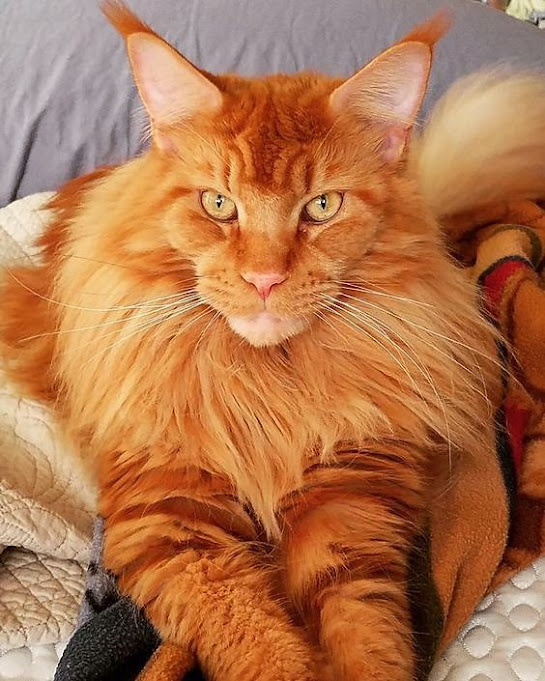
Under the Cat Fanciers' Association (CFA), the Maine Coon coat should be heavy and shaggy, shorter on the shoulders and longer on the stomach and britches. A full-frontal ruff is desirable, and the coat texture should be silky with the coat falling smoothly. That's the breed standard.
 |
| Cream Maine Coon with shaggy fur. Image: Pinterest. |
A study published in October 2021 (see full citation at base of article) which is quite recent, found that the gene which causes long hair in cats can be heterozygous or homozygous and this affects the "longhair phenotype in about 3% of these cats". That's a reference to Maine Coon cats. Heterozygous means "having two different alleles of a particular gene or genes" while homozygous means having two identical alleles.
It's a tricky subject to discuss but research indicates that hair length in domestic cats varies a lot, and this variation is due to mutations of the recessive gene known as the: fibroblast growth factor 5 (FGF5) gene.
The study found what they describe as a "missense mutation in FGF5 c.577G > A p.Ala193Thr". They screened 2 Maine Coon cats which were identified as having only one copy of the FGF5 mutation. This means that these two Maine Coons were heterozygous for the recessive gene mutation rather than homozygous.
The study concluded that the "novel mutation" of this gene which dictates hair length contributes to the longhair phenotype (appearance) in about 3% of Maine Coon cats.
I will try and interpret that and if you want to read the abstract to the study then please click on this link.
My interpretation is that some Maine Coon cats are heterozygous to the recessive gene known as fibroblast growth factor 5 (FGF5) and which mutates. So, when there is one copy of this gene it's going to be inherited in a different way to when there are two copies (homozygous).
My interpretation is that inbreeding will sometimes but rarely allow the recessive heterozygous gene to have an effect on the appearance of the cat.
The scientists concluded that this is a breed-specific variant for the Maine Coon. For me it provides an insight into Maine Coon breeding. I would doubt that Maine Coon breeders are aware of this. They might just see the effects which is an unexpected variation in coat length in some of their kittens,
I'm only able to briefly discuss this topic because I only have access to the summary of the study. If I wanted to read the entire study, I would have to pay £30 and I don't want to do that every time I read a study about Maine Coon cats!
The study: Shaffer, G.D., Ballif, B.C., Meurs, K. et al. Identification of a novel missense mutation in the fibroblast growth factor 5 gene associated with longhair in the Maine Coon Cat. Hum Genet 140, 1517–1523 (2021). https://doi.org/10.1007/s00439-021-02373-1



Comments
Post a Comment
Please share your Maine Coon experiences.