
Air pollutant health risks to Maine Coon cats inside the modern home
This is about people and cats living in modern homes. I'm going to refer to an article in The Times newspaper today which is about the UK, but it refers to all modern homes. And the reason why modern homes are relevant to this discussion is because there is less ventilation in them. There are less gaps and holes around windows and in other parts of the home which provide natural ventilation.
 |
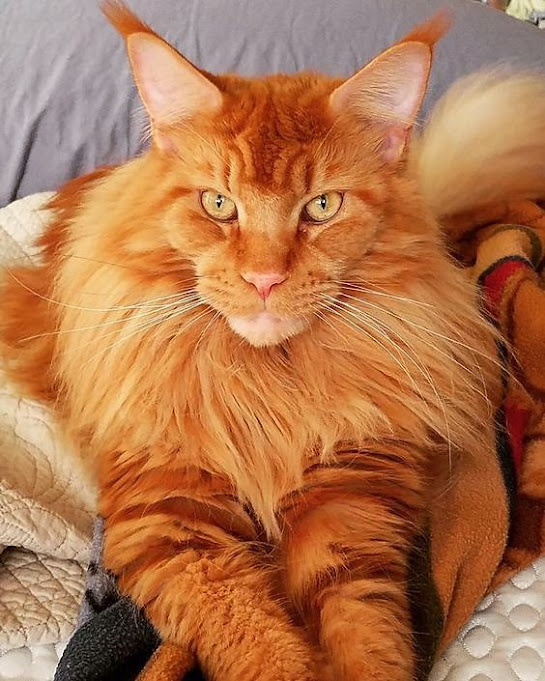
| Maine Coon lounges on a sofa. Are they safe from pollutants? Image believed to be in the public domain. |
The modern home is sealed up with double glazing for, ironically, environmental reasons. The idea is to keep the heat in to minimise the use of energy which at the moment often comes from gas, oil and coal, dug up from the ground and producing carbon dioxide when burnt which warms up the planet.
It's ironic, too, that the urban environment is becoming slightly healthier because of electric vehicles (EVs) but relatively speaking inside the home is becoming more polluted. Tackling indoor pollution should be a priority because of the significant health harm it can do to people and pets.
This article is relevant to Maine Coon cats because they are more likely to be full-time indoor cats. That is their world, their environment. It should be as good as possible both in terms of entertainment, stimulation and minimising the pollutants.
And the pollutants come from a variety of sources. Years ago, I wrote about chemicals in carpets potentially being a health problem and there's always the well-known fire retardants in furniture upon which cats rest very often as you can see in the photograph.
Feline Diabetes caused by fire-retardants in carpets, curtains and upholstery
But beyond those, the following items pollute the indoor environment:
- Cooking particularly from gas hobs where an extractor fan is not being used.
- Wood-burning fires. Burning wood indoors has been linked to asthma and lung infections in children.
- Exposure to high concentrations of volatile organic compounds such as cleaning products, paints and solvents are linked to a heightened risk of cancer and liver and kidney damage.
- Cleaning products.
- Candle burning.
- Incense.
- Air fresheners.
- Deodorant sprays.
- Lemon smelling products such as air fresheners and cleaning products are based on limonene, a volatile organic compound that can be harmful to breathe.
There are other items. As you can see there are lots of them.
Cats in front of wood burning fires or stoves might expose them to carcinogens
Prof Frank Kelly of Imperial College London, said:
"Cooking is a major problem in a lot of households".
Note: during the well-known cost of living crisis in the UK, it may pay people to stop cooking and eat items that don't require to be cooked both saving in costs and reducing pollution in the home! I rarely cook 😎✔️.
England's chief medical officer, Chris Whitty, with whom we are very familiar thanks to the Covid-19 pandemic, said:
"Eighty percent or more of someone's average day is spent indoors. So if there is indoor air pollution it is important because people are exposed to it for a longer period."
The same, of course, can be said about domestic cats and dogs. Typically, when journalists and scientists write about indoor air pollution, they confine their discussion to people which I believe is an omission. We must bring into the equation cats and dogs and other pets.
Although we know that in England up to 38,000 people die prematurely because of outdoor air pollution, we do not have statistics regarding indoor pollution. Research is at an early stage, but we know that indoor air pollution is a major issue.
A lot of it comes from modern products. Kelly said:
"A lot of these modern products, unfortunately, bring pollution into our home. Whereas the previous generation just put some vinegar in the water and used that as a very effective cleaning agent."
Chris Whitty has published a report today which demonstrates what he describes as the "massive difference" between various sources of home heating.
Electric systems such as a heat pump have zero carbon dioxide emissions per megawatt hour. Gas-fired boilers have 0.72 g of carbon dioxide emissions per megawatt hour. Open fires cause 2,950 g of carbon dioxide emissions per megawatt hour. This figure is reduced to 335 g for eco-design wood-burning stoves.
Surge in Human Thyroid Cancer Due to Flame Retardants in Sofas and Mattresses
Ventilation in the home is very important but, in the winter, people have their windows closed and the home becomes sealed. This places a reliance upon air purifiers in the home. But not everybody can afford to run air purifiers particularly during a cost-of-living crisis.
I have always felt that people should not assume that the indoors is entirely safe for their companion cats. There are these hidden dangers which we can't see, smell or hear. Cats are particularly exposed to them when they live indoors full-time. I believe that we should pay more attention to this potential hazard.
There are quite a few idiopathic (unknown causes) diseases in cats, and I suspect that some of them are caused by these pollutants. I would ask for a scientific study to delve into this in detail. And thereafter the government should consider placing regulations on the manufacture and distribution of these products including health warnings on the packaging.
Per- and polyfluoroalkyl substances (PFAS) toxic to domestic cats



Comments
Post a Comment
Please share your Maine Coon experiences.